Showing posts with label remote living. Show all posts

Tuesday, August 11, 2026

Magic in the Air*

Another county fair has come and gone, and we have covered ourselves in glory once again.

Or at least got some ribbons.

Lemme show you!

The first day of the fair is just a day for entering the projects in the community building and dropping off animals for showing. We don't show animals, so for us, it's just bringing in our projects.

This year, that was gingerbread, a purse, and a watercolor painting from Poppy. 


Please enjoy these awkwardly-cropped photos that got rid of the names of our county and the children.


She actually sewed this just randomly for her best friend (by hand, with no pattern or anything), and then when she needed a fair project, I suggested she enter it before giving it to her friend.


And her watercolor.

As you can see, her gingerbread won grand champion in the child's baking category. She was very proud of this, particularly because my buckeye brownies only got first place, not grand champion.


Not-champion brownies.

It was kind of funny that the judges' notes on Poppy's gingerbread included the comment that it had a strong molasses flavor and she might consider substituting some honey for the molasses. We do not agree with this. It's supposed to have a strong molasses flavor. But to be fair, it's also supposed to be eaten with whipped cream, which we could not give the judges, so that affects the flavor, too.

Anyway.

I also always enter whatever I can get from the garden. This year, that was leeks, carrots, and garlic.


All prettied up for judging.

The leeks won grand champion in the agricultural products category.

I also always enter something canned. This year, the only thing I had was some rhubarb jam. I brought it, but it was literally the only thing entered in the canned goods category, so they didn't bother judging it.

(I should probably note here that our county is very small, which means our county fair is very small. Like, VERY small. I think there were only a dozen entries total this year in baked goods, and only a few people entered vegetables.)

One boy chiseled a cross into stone.


This didn't really place, but I feel like that's because the judges have no idea how difficult this is to do.

And another boy did a collage from "Fur, Fish, Game" magazine.


Featuring many dead animals, because that's what the magazine is about.

A. entered a watercolor flower, too, which got first place.

So! Very successful, yay us, etc.

The second day of the fair is most of the animal showing. We don't show animals, but many of the children's friends do, so we always go to watch them manhandle goats and steers in the ring. I didn't take any photos of that this year, though.

The third and final day of the fair is my kids' favorite. It starts with the parade. This year, the older two kids were on the FFA float, so it was only the younger two picking up candy. There was a lot of candy this year, thanks to the many political candidates who were campaigning.


Never any chocolate, though, because it's way too hot at the parade and chocolate would just melt.

The next exciting thing is the rodeo. Before the riding events, which my children do not participate in, they have a couple of fun activities for any kid. This includes goat dressing, which is catching a goat and getting a t-shirt over its head. Also the calf scramble. This is in a large pen where all the kids go and they release several calves in with them. The calves have money rubber-banded to their tails. The kids chase the calves and pull the money off their tails. This is actually really hard, and somewhat perilous, as the calves have been known to kick, or to turn and run down their pursuers. I've never seen anyone get really hurt doing it, though, even the littlest kids.

The dance at night is the last fair event. I always take any kids that want to go. We only stay a couple of hours, because we have church early the next morning. They always get a live band, which I particularly appreciate. Everyone knows how to two-step, so everyone, from little kids to elderly people, dances. Parents dance with their children, brothers dance with their sisters. It's fun.


It takes place in the same pavilion the livestock are shown in. Properly cleaned up, of course.

And that was it for this year's fair! It's always a very tiring three days, but they are some of my kids' favorite days of the year and they're already looking forward to next year's fair.

* Lyrics from this Chris LeDoux song, which we always have to listen to as we drive to the county fair.

Tuesday, June 2, 2026

Room to Roam (and Park)

Although there are many things about the place I live that are markedly different from mainstream America, one that I am always reminded of when traveling is parking. 

Parking, you say? How can that be much different?

Well, let me ask you this: Do the places you park frequently have enough room to pull through in a crew-cab truck pulling a livestock trailer? No? Mine do.


Where I park at the bank.

Most places here--including schools, municipal buildings, and everywhere in the village--are set up that way because many people are driving such a set-up at any given time. That sort of thing can't be easily backed and turned, so pull-through parking is pretty much always an option.

I don't ever drive trucks with trailers, but I appreciate having parking set up for them. Back when I drove our 12-passenger van daily, I hated going into town and having to park in a small parking lot somewhere. So nerve-wracking to back that thing up in a tight space with cars hemming me in. But it's not something I have to worry about here.

Wide open spaces for cattle, people, and cars. Just the way I like it.

Tuesday, March 31, 2026

A Vegetable Lull

The current contents of my refrigerator crisper drawers include five medium carrots, two mini bell peppers, and the last few small interior leaves of romaine lettuce. It has been two weeks since I have purchased any fresh produce at a store, and even that was just a minimal stop at a very small store in a very small town.

And yet, I eat salad every day.

I have been doing this by eking out my remaining lettuce with chopped collard greens from the freezer and relying on pickled beets and onions as other add-ins, besides the carrots and mini bell peppers.


Last night's salad before adding the pickled beets from the jar.

Similarly, vegetables for the rest of my family have mostly been coming from the freezer.


Last night's fried rice included frozen peas, collard greens, beet greens, and a few dandelion greens I picked by the back steps.

There's still cooked cabbage, squash, green beans, peas, and corn in the freezers. There is sauerkraut from what I canned last summer in jars on the office shelves.

We have zero fresh fruit right now, but I do still have canned apples and pears and applesauce. Plus some store canned peaches.

It has been a recurring event in my adult life to have periods of time where the stock of fresh produce in my house is very low, but it doesn't really bother me. It's just part of living really far from stores. And it's why I keep fall-back vegetables and fruit in freezers and jars.

Anyway, it just makes it that much more exciting when I do finally get to the store and come home with such thrilling things as oranges, bananas*, and cucumbers. It's the little things in life.

* My children do actually consider having fresh bananas to be a notable luxury. Low standards, as always.

Tuesday, February 4, 2025

The Milk Situation

I spend more time that your average person plotting about milk. This is a result of both our remote location so far from stores, and the fact that we just go through so much milk. 

We will use five gallons a week of milk, if we have it. Keeping that much milk on hand at all times is very difficult when the nearest store is 60 miles away. And that store doesn't have reliably good milk, either.

Here's the breakdown for our milk supply*.

There is a very tiny kind of convenience store that's about 10 miles away that sometimes has milk. It's good quality, but sometimes it's all been purchased. And often, the store isn't open when it's supposed to be. So that's not a reliable source.

The next-closest store is 60 miles away. They have a good quantity of milk on hand at all times, but it often goes bad quickly, or is actually kind of off when we open it. I'm guessing that's because they're at the end of the supply lines and so the milk has had to travel a long time and be exposed to a lot of loading and unloading temperature changes on a truck. So I avoid buying milk there if I can.

There are a few regular grocery stores within 90 miles that always have milk, but one of them has the same problem of quality as the closer store because it's on the same trucking route. In fact, almost all the stores we go to have some problem with quality and longevity. More often than not, milk starts to separate or just plain taste bad before we get to the end of the four or five gallons we buy at a time.

The absolute best place to buy milk is Walmart. It is always fresh, it rarely goes bad within the week, and it's the cheapest, too. But of course, there is only one Walmart we can get to, and it's 90 miles away. 

Where we buy milk has everything to do with where we need to be for something else, usually a basketball game or a hay run in the winter.


And how much of this I want to stare at to get to it.

So figuring out when and where to buy milk this week looks like this:

We currently have 3/4 of a gallon of milk left. The last gallon of milk we opened from that same grocery run started separating immediately, which means this one will probably not last long. I can probably water it a little bit and make it last two days, but that's about it.

I had been planning to go to Walmart on Thursday and then stop at a basketball game on my way home, since I had to be going that way anyway. But now that basketball game isn't happening.

So.

Will the very small store in the next village over be open today? Will they have milk? If yes and I can get even one gallon of milk, we're good until Friday. The hay place in the big town with the Walmart is open on Fridays, so A. could go get milk then.

I could just go to Walmart this morning, bypassing the small store entirely, but that would be a trip solely to go to the grocery store, which feels like a waste because it's so far.

If I can't get milk at the small store and don't go to Walmart today, we will be out of milk for at least two days. This happens somewhat regularly and it's not the end of the world, but it's annoying.

I know someone is going to say, "Why don't you just get a milk cow?" Because I do not want a milk cow. I know exactly how much work that would be for me, and frankly, this sort of convoluted planning is easier for me than milking every day, sterilizing equipment, making cheese, etc.

Anyway, that's where I am today: Pondering whether I want to drive two hundred miles roundtrip for groceries. Stay tuned.

* I bet you never expected anything so fascintating when you showed up today, right? Right. 

Tuesday, August 6, 2024

The Remote Chauffeur

Like most parents of older children who cannot yet drive, I spend quite a bit of time driving my kids to wherever they need to be. Unlike most of those parents, however, my drives are a lot longer. Also more scenic.

I had a particularly driving-heavy day a bit ago, and I documented it for you in photos.

You ready? Let's go!

First up was getting my eldest to his job. He's been working at a ranch down the hill this summer. It's an outdoor job, and he starts very early to avoid the worst of the heat, so we were leaving the house just before sunrise for the 25-mile drive to the ranch.


The last five miles are on a caliche road.

I stopped on my way back up the hill to take a picture of the rising sun.


It was unusually hazy on this morning.

Just a couple of hours after I got home from that excursion, I went back down that same hill to bring another child to a town for his school vaccinations. That was another 120 miles roundtrip.


On the road again . . .

And just about an hour after returning from that, I got back in my trusty old Honda to take Poppy to her friend's house for a sleepover. Thankfully, her friend only lives about twenty miles away.


She's on a pretty remote ranch, but at least their house only requires about a mile and a half of off-the-pavement driving on their driveway. Some of the houses on this ranch are twenty miles or more off the paved road.


Nice views on the way home.

So all together, I drove around 250 miles to get my kids to work, the doctor, and a sleepover.

Thankfully, I do not have days like this often, but it's just another part of parenting in Remote America.

Thursday, July 14, 2022

A Much-Delayed Answer

Several weeks ago, Natalie left a comment asking what the commodities food is that I talk so much about. And I apparently completely missed that question when it was asked.

I'm sorry, Natalie! I wasn't blowing you off on purpose, I promise!

It's a good question, and I'm sure others have wondered as well, so I'm going to answer it here now. 

Our county has a program funded by the USDA whereby anyone below a certain income level can get free food. I suspect it's the equivalent of a food bank, but since we live so far from any distribution centers, it's just sent to us.

Once a month, anyone in this program gets a big box of food that includes pantry items. We've also seen fresh and frozen meats and other refrigerated things. In addition, there's a box of fresh produce. There's also a dairy box with milk, butter, cream, and so on, but I don't know if they get that every month.

I also don't know if all the elderly people here are below the required income level, or if the program automatically provides the food to anyone over a certain age, but all the older people we know get these boxes. 

We are not signed up for the program, but we get these things secondarily from our neighbors because they can't eat it all. They mostly give us the pantry stuff. A single elderly lady is unlikely to be eating a pound of split peas every month. So we get a LOT of split peas and other beans, along with rice, spaghetti, canned tomato sauce, and canned vegetables.

Some of this stuff just goes to our chickens, because I really am not a fan of canned vegetables and we don't really eat that many split peas.

In addition to our neighbors' extra foods, the lady who distributes the boxes--also a neighbor--stops by after she's done her delivery route and gives us some of the extra things. This is why we get one or two produce boxes every month. I have no idea how this program is supplied, but there's also always something particular she has in ridiculous excess. Last month, that included flats of strawberries and many, many packages of pretty fancy bread from a bakery. 

And when I say excess, I mean she has a pick-up truck bed full of food. Since Covid, the supply of foods for this program has actually increased. Again, I don't know how this program actually works, but I know they always send way more than is used here. And we get the overflow, because otherwise it would just be thrown out.

So there you go! That's what I mean when I mention commodities food.


Wednesday, January 26, 2022

Remote Living: Snow Days

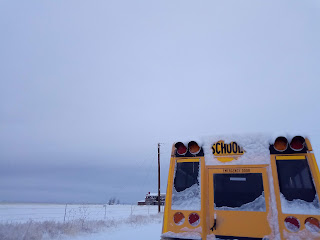
I woke up to at least four inches of snow this morning, which began the flurry of phone calls to the tune of "Will the School Buses Be Running Today?"


Patiently waiting for the answer.

In New York, school superintendents made the call regarding snow days based on whether the plows would be able to keep up with the weather. But that strategy is dependent on the roads actually being plowed at some point.

That is not the case here.

We do have snowplows here, but far fewer of them, and they don't even try to plow most of the roads in the county. Because there is only one paved road. That road is kept pretty clear, but all the innumerable dirt roads, to say nothing of the lanes and long, long dirt driveways that lead only to one ranch house? They don't even try to plow those. If you live at the end of a seven-mile dirt driveway, you get out in your 4-wheel drive, or not at all.

Most of our students are in the latter situation. A.'s bus route is over 100 miles every day. Exactly zero of the kids on that bus route live on the paved road. Almost half of the route is on unimproved dirt roads. 

And in addition to all of that, each of the buses (there are only two) has to go up and down a steep hill with switchbacks.

This is why, when we have snow or other bad weather, the superintendent calls the bus drivers to see if they think they can safely run their routes.

This morning, the answer was no. 


The sign says it all.

Luckily for the school in this age of COVID, all of the students have their own laptops, so it's easy to send the kids home with their computers when the forecast calls for inclement weather, and then make the call for virtual schooling in the morning.

Unluckily for the kids in this age of COVID, that means no more snow days.

It is much safer, though, and less nerve-wracking for the bus drivers. Because driving unplowed dirt roads for a hundred miles is no one's idea of a good time.

Wednesday, November 24, 2021

Remote Living: Going To the Zoo

Heads up: This is a very long post. Just thought I should warn you to settle in.

Going to the zoo is sort of a cliche for parents of young children, right? Zoos are fun! They're practically made for kids! It's a perfect place for a family-friendly outing!

All true. But most people don't drive 400 miles round trip for that outing. We do. So I thought I would explain how any sort of family outing for our family looks*. 

This particular outing came about because I was reading a book about sharks to Poppy and Jack, who were enthralled with a photo in the book of one of those underwater tubes that go through a big tank in which the sharks swim all around. "I wish we could see one of those," Poppy said wistfully.

I actually had no idea where the nearest aquarium was, so I looked it up. Okay. Albuquerque. Where there is also a zoo and botanical garden.

That's not close to us, but it is at least within the realm of possibility for a day trip. I considered that Thanksgiving break was coming up. And that I now have four fully mobile children who do not require strollers, diapers, or too much special care. And that they can all handle a three-hour+ drive without complete meltdowns.

We could actually do this. So I talked to A.--who is always willing to take a trip anywhere--and we decided on the Friday before Thanksgiving.

The zoo/aquarium/botanical garden complex opened at 9 a.m. I wanted to get there as early as possible, so we wouldn't be getting home at an unreasonably late hour. To get there at 9 a.m., we would have had to leave at 5:30 a.m. I decided to shoot for a 6 a.m. departure.

The night before, I had all the kids pick out a book and two toys to take with them in the car. I added a couple of books of mazes and puzzles that I had intended for Christmas but figured could be put to better use on this trip. I also put together a backpack with masks (required for indoor exhibits), snacks, and sunhats to carry around the zoo.

I got up at 4:30 the morning of and put together a bag of food for car snacks and a cooler of food for either lunch or dinner (tuna salad, bread, carrot sticks). I filled a water bottle for each person and made sure we had the extra gallon of water in the car, because we don't go ANYWHERE without the extra gallon of water. Last, I made some fried egg sandwiches for breakfast in the car.

While I was doing this, A. was putting food out for the chickens for when it got light, feeding the dogs, and filling containers with water to bring to the sheep.

I woke the kids up around 5:45 a.m., helped them all dress appropriately, and loaded everyone up. It was 6:15 a.m. when we pulled out of our property.

We stopped at the pasture down the road where the sheep are so A. could fill their water. We stopped at the village pump house to turn off the water pump A. had turned on the night before to fill the well. And then we had to turn around when we were about two minutes down the road because I forgot the zoo backpack.

Sigh.

But! We were still on the road by 6:30 a.m. And then we drove drove drove. I judiciously apportioned snacks and the entertainment to make sure I had something to appease the troops in hour three when everyone reeeeealllly wanted out of the car.

We got to the aquarium a little after 10 a.m. The kids were so excited by the giant tanks.


River otters!


Jellyfish!


SHARKS!

Next we went to the botanical gardens.


Giant wisteria tunnel!


Children's garden with little caves!


And a slide!

We had to drive over to the zoo, and considered getting lunch on the way somewhere. However, we didn't want to take the time, because it was already 1 p.m. and we had a long drive home (obviously). So instead we ate our tuna sandwiches on a bench next to some somnolent crocodiles and started the zoo rounds.


Lions!


Ducks to feed!


A carousel!

After seeing everything--and completely exhausting that little camel rider up there--we got back in the van at 3:30 p.m. And drove drove drove.

We took a break in the small city 90 miles from home to eat dinner at a Chinese restaurant. It added an hour to the trip home, but the kids were so thrilled to be eating in a real restaurant. They never, ever do this, and it was a big deal. In fact, it was the first time in Poppy's entire four years that she ever actually sat in a restaurant to eat a meal. It did mean we didn't get home until about 8:30 p.m., though.

So for those of you keeping track at home, our outing was about 14 hours, 400 miles, and 4 extremely tired but happy children.

Worth it.

*Mostly I just wanted to post a bunch of pictures, though. Because it's my blog, and I can.

Wednesday, November 3, 2021

Remote Living: Halloween

I'm sure someone out there is wondering how a family with children handles Halloween a hundred miles from anywhere. The answer, as with so many other things, is we drive.

A little, anyway.

Our children do go trick-or-treating. In pre-COVID years, all the kids from the school would actually ride on a flatbed trailer and go all together. This is in the same village where our kids go to school, which is ten miles away from our house.

Starting last year, though, the separate groups went on their own, and we are the only ones who make our kids walk.

Yup. We're those parents.

It is, in our defense, a pretty small village. But definitely not as small as the number of inhabitants (less than 100) would indicate. 

We visited exactly nine houses this year. Two of those houses were ones we stopped at in the car on the way in to the village, but the other seven were the ones we walked to. It took us a little over an hour to get to those seven houses.

The village is surprisingly spread out, and also more than half of the houses are unoccupied. So it takes a lot of walking to get to the houses that give out candy.

But! Lest you are imagining the kids sadly trudging between houses only to come home with exactly nine fun-size Snickers, please feast your eyes on Jack's haul.


Not too shabby.

So few kids trick-or-treat in our village--this year there were exactly 13 kids, which is a pleasingly appropriate number--that at each house, they get handfuls of candy. Or they get offered a full bowl and are told to help themselves. And then they get some more thrown in their bags. So their actual take from those nine houses is pretty good.

Most kids on the surrounding ranches go to larger towns for trick-or-treating, and they no doubt get more candy. But I don't really think kids need much more than ours get going around that tiny village. And they LOVE running through the darkened streets. That village is just as exciting for them to trick-or-treat around as a densely populated suburb or city street. A lot safer, too.


Superdancer's pile made her plenty happy.

So there you go! Halloween in the sticks: still plenty of Fun Dip to go around.

Wednesday, September 8, 2021

Remote Living: Sports

After a short lull, there was another question about remote living. Shall we?

An away game three hours away? How exactly does one handle sports in that regard? 

This is a good question, because it really is just that crazy.

Our school is so small that students there actually play football with the school twenty miles away, and even then, it's only six-man football. There just aren't that many schools that play six-man football, so to have any games at all, there is a lot of driving.

Yes, the away games all require over two hours of driving. The game last week was on a Saturday. So they left here at 10:30 a.m. and took the team to lunch before their 4 p.m. game. 

A. went to watch, so he brought Cubby home. They got home around 9 p.m.


I actually took this photo during a different trip, but it illustrates the experience quite well. Minus the darkness and driving rain that caused A. to have to pull over before they got home.

One of their upcoming games is against a school that is over five hours away. For that one, they'll pick a mid-point school to meet at and both teams will travel a couple of hours to play.

Volleyball is also going right now. They have a lot more games--because there are a lot more teams--and they do occasionally need to do things like leave school at 11 a.m. on the day of the game. And there are definitely days they get home very late. 

Although there are club sports for things like Little League, we told our kids that they had to wait to play anything until they were old enough (sixth grade) to play on a school team. Because then the school takes care of transportation. 

We just could not handle driving literally hundreds of miles a week for Little League games and practices. We have too many kids, and that is just too much of a time commitment and disruption in our family life. 

For people who are really into sports, the travel is worth getting their kids involved. We are not those people, however, so school sports it is.


Wednesday, August 18, 2021

Remote Living: Alas for Italian Sausage

More questions!

Has your cooking changed much since the move?

In some ways. It was a good thing that I already had some experience with growing, harvesting, preserving, and butchering, because those things are obviously much more important out here where our access to high-quality food is greatly hampered by distance. I mean, we can buy food, obviously, but it's not always what I might want or the quality I wish to have.

As for the differences in actual ingredients . . .

Is it more because of what you have access to, or what you don't have access to?

Both. I have always allowed my environment to dictate what's in my kitchen. So in New Mexico, it was inevitable that I would end up using green chiles in my cooking, which is an ingredient I had never in my life cooked with.

Likewise, I'm sure I would never have started making my own tortillas if I weren't living somewhere with ten varieties of masa at the grocery store. 

Also, although we have always made an effort to buy cows wherever we have lived, it's so effortless to do here in cattle country, we have and eat more beef. 


Cows are so numerous here, they're often the only impediment in the road when we're on the school bus.

What I do not have access to here that I used to rely on a lot more are quality dairy products and Italian sausage.

Upstate New York is a paradise of dairy. It's easy to find unpasturized heavy cream and real aged cheddar cheese. It is not easy to find those things here. It is, in fact, impossible to get real cream without milking your own cow.

Italian sausage is something I always had on hand in New York for a quick meal. Here, it's not an option. I don't like spicy sausage, and that's the dominant kind of sausage here. Also, it's not really high-quality sausage. It tends to be too much fat, gristle, and salt.

Oh, and apples. There are some local apples, but they tend to be kind of dry and tart. Not good for applesauce or baking, so I don't make the same quantities of applesauce I used to make, which the children miss.

Wednesday, August 11, 2021

Remote Living, Part 13: Trash Talk

Just a quick one today, with two questions.  Because "Let no questions be left unanswered" is my motto.

What do you do with garbage if you have no garbage pick-up?

As with so many things here, we do it ourselves. 

The villages have what are called transfer stations. These are places with really big dumpsters where locals bring their trash, and then the trash is trucked out eventually.

We go about every other Friday and bring a few bags of trash to the transfer station about ten miles away. And when I say "we," I mean "A. and Poppy." Poppy LOVES going to get rid of trash. The stop at the small store in the village for a treat that she usually manages to charm out of Daddy might have something to do with it.

Edited to add: The comment from Linda reminded me that I should have said I do burn cardboard and paper in a burn barrel. Burn barrels are, uh, barrels. Made of metal, so they won't melt while you're burning things.

What about recycling?

Unfortunately, that does not exist here. As far as I'm aware, the closest recycling center is a two-hour drive. So we don't recycle.

Edited to add because man, I was tired when I wrote this and forgot stuff: Except! All food waste is taken care of either by the chickens, the dogs, or the compost pile. I consider that recycling. The chickens recycle the scraps into eggs, the compost recycles it into garden fertilizer, and the dogs . . . okay, the dogs don't really recycle it. They just eat it. But they keep the coyotes away, so they're worth a few scraps.

Let's end with a photo, shall we?


We may not have garbage pick-up, but we can ride a horse anytime we want. Trade-offs.

Wednesday, August 4, 2021

Remote Living: Gifted Animals

As you might have gathered from my "Vitals" column over there on the right, we have a lot of animals. And many of them were given to us.

Most of our chickens were given to us by neighbors.

Our meat rabbits were given to us by a neighbor.

Samson was given to us by a teacher at the school.

And now, from another teacher, we have . . .


Everyone, meet Bill.

Bill is a Welsh mountain pony. I think of ponies as stocky, furry little things, but Bill really just looks like a miniature horse. He belongs to the teacher's son, who used him for his very young daughter a few years ago.

We weren't sure how much training Bill had. Turns out, almost none.

He may have been fine for leading a little child around a few years ago, but it's clear that whatever training he had then has been forgotten. It took A. fifteen minutes to catch him in the smaller paddock just to get a halter on him. It seems a safe bet that he's been running around in a pasture for the past few years with no contact with a halter, much less a saddle.

Luckily, he seems to have a very good temperament, which will help. Because A. is going to have to train him. And Cubby is going to have to ride him during the training. Bill is too small to carry A. around, so Cubby is our most experienced rider Bill can comfortably carry.

Cubby and Calvin are happy to have a more lively horse to ride, because geriatric Samson pretty much tops out now at walking a quarter mile to the post office with Poppy on his back. He's a great first horse for a small child, but the older children are ready for more of a challenge.

And I think Bill is just the pony for the job.


Wednesday, July 28, 2021

Remote Living, Part 11: Utilities and Remote Kids

And the questions march on . . .

Any utilities?

Water (more on that below), electricity, high-speed Internet. That's it. No garbage pick-up or sewage.

Do you have a well? 

Our almost-ghost-village has a well, put in in the 1980s I think. It supplies three houses and the post office. We pay a very low flat fee monthly and have no restrictions on use.

We have good and plentiful groundwater here, which is the reason the town was built here. Before the village well, everyone had their own wells, and/or used windmills to pump water up. The two neighbors who don't use the community well still use their own wells.

Our water association (which is a funny name for something with four members) is run by our neighbors. The husband of the pair is very handy and takes care of the maintenance, and the wife does the paperwork and finance part of it.

Since we've lived here, we've never been without water for more than half a day. (Knock on LOTS OF WOOD.) 

But, if we need to, we can always haul water from our neighbor's stock tank*. 


The tank is also a favorite place for our kids to visit when there's no livestock in the pasture, because the tank has many goldfish in it. Water supply and aquarium in one. (That white fence in the background is our house.)

It's in the pasture across the road from our house, and there's a gate right there that opens so you can drive a vehicle to the tank. It's supplied by a windmill, so power loss doesn't affect it. We've only had to use it once, but it's nice to know it's there and we can get water if we really need it.

Do the kids like living in the middle of nowhere?

In the interest of accurate reporting, I posed this question to the kids in question. (Cubby wasn't there when I asked this question.)

Poppy: Yes.

Jack: Yeah.

Calvin: Yeah. It's better than the other places we lived. (Editor's note: Neither of which were exactly bustling urban centers.)

Of course, they haven't really known anything different, since they've lived rural their entire lives. But whenever we visit family in more populous areas, they all remark on the traffic and noise and seem relieved to get home.

They don't really understand how unusual it is here.


I mean, how many other kids do you know who regularly ride a horse to the post office?

This may change as they get older, and I think there will probably be some culture shock when they move elsewhere as young adults. But for now, they're happy.

* Another example of how our good relationships with our neighbors is key to living here.


Wednesday, July 21, 2021

Remote Living, Part 10: Amazon and Remote Pets

Two more burning questions about remote living that must be answered before you all can sleep at night.

Or something.

How long does it take Amazon stuff to reach you? 

It used to be that I would actually get things ordered with Prime shipping in two days. Our UPS driver actually comes from a small city a couple of hours from us--I can't imagine doing that job with as much cheery goodwill as our long-haul UPS driver--and so there really wasn't a big delay getting anything.

Lately, it seems as if most shipping is a little wonky, so it might be an extra day or so.

I do not, however, often request the Prime shipping. I'm not in a big hurry for the majority of the things I order, so I usually go with the slower shipping that rewards me with digital credits. That way, the kids can eventually watch a movie on Prime for free. 

Is there a traveling veterinarian for animal needs?

No. At least, not for small animals. Our vet--who is 90 miles away--does large animal work, for which he necessarily travels to ranches. But small pets have to be brought to him.

That said, our dogs have been to the vet a grand total of three times in their two years--twice for vaccinations, once for neutering--so it's not a frequent issue. We have crates for each of them, and once they're in there, they just settle in. I'm sure they don't enjoy it, but it's not a big deal.


At home and chillin'.

What's more interesting, and something I never thought of until we got these dogs, is that they have never been on leashes. And I mean never. Not even once. They just don't need them. They come when they're called; they don't run off; and they have the run of a half-acre, fenced-in property that keeps them in away from cars.

I suspect it's because they're from a line of working ranch dogs, with strong instincts to follow orders from humans and stay with their human masters, so it just isn't an issue. We certainly didn't spend a lot of time training them, so it must be instinct.

Even on our recent trip to the Outside World, we never put them on a leash. We purposely stopped places and stayed somewhere without a lot of people, traffic, or other dogs, so they wouldn't be overwhelmed. 

They do have collars, so we can grab and hold them if necessary, but no leashes. 

Wednesday, July 14, 2021

Remote Living: More Questions!

These aren't specific to remote living, but I'll answer them anyway . . .

What made you move from New York to New Mexico? 

Two big reasons: One is that the majority of our families live in Arizona now. We wanted to get closer to the cousins, aunts and uncles, and most of the grandparents (the lone exception being the MiL, whom we sadly left behind in New York).

The other is that the cost of living is SO much lower in New Mexico. This enabled A. to work less, and us to buy a house that we now own outright, and just generally not deal with the financial strain of living in a place with high taxes and multiple fees for things like vehicles.

How did you find your house and the area you wanted to live in?

A. drove through here a couple of times years ago on his way to and from college, which he attended in Tucson, Arizona. He had a favorable impression of the area, and so when we started trying to find a place within a day's drive of Tucson, he thought of here. 

He also did a lot of research about cost of living, schools, climate, etc., because he's really into data. The school issue eliminated a lot of communities we were considering.

The school district here maintains a couple of houses that are technically "teacherages" that they can rent out. So the first house we lived in was one in the village that we rented from the school. The house we live in now was for sale then, but we wanted to rent first to make sure we wanted to stay here. The house we bought was literally the only one for sale in the county, so that made it a pretty easy decision.


Random photo of the old schoolhouse as the sun rises.

And lastly, although this wasn't phrased as a question in Monica's original comment . . .

How did you overcome fear of the unknown and the obstacles to moving cross-country to an entirely unfamiliar place?

This is something I have much more trouble with than A. does. He thinks of new places and moving as exciting adventures, and simply assumes that he will deal with any obstacles as they present themselves.

I, on the other hand, worry and fret and really, really hate feeling unsettled.

However. 

It was my great good fortune to grow up as a military child. Thus, I saw my parents move a family every three years, often very long distances (Hawaii to Alaska, for instance). They bought and sold houses; my mom found jobs; and my siblings and I went to new schools, found friends, and all turned out pretty well.

Having had that experience as a kid means that, although moving is not my preference, I know it can be done. I knew I could do it, and I knew my kids could do it. So when it seemed as if moving was the best option for us, I did it despite my natural inclination to avoid big changes.

Okay! I would say this is the end of this series, but we all know by now it will never end until the questions do. So tune in next Wednesday to see what comes next.


Wednesday, July 7, 2021

Remote Living, Part 8: Carrying On

You thought we were done with this, didn't you? Nope.

There were a few more questions, and I am not the woman to leave any question unanswered. 

How long did it take you to develop relationships with people in town? 

No time at all. This is the most welcoming small community I have ever lived in. People would stop and introduce themselves to us at the post office, or in our yard if we were outside, or on the playground. Integrating into a community is much easier if you have children, because of course you are immediately part of the school community. (Assuming you're not homeschooling.) And in a small place, the school is the hub of everything.

That, and church. We met almost everyone in one of those two places.

But here is where I have to give some general advice about integrating into a small community: For the first year or so you live there, listen, don't talk. You are coming in as an outsider, and no matter how friendly the locals might be, no one likes to feel as if they are being judged. If you come into a community and immediately start trying to change things or organize things or whatever, you run the risk of coming off as critical of the place you moved to.

We spent the first year we were here just figuring out how everything worked, who everyone was and how they related to everyone else, and then we let our place in the community develop from there. Eventually, we were asked to take jobs or serve in various capacities at church. That is when you know you have been accepted as a community member.

Do you have get togethers with other families? 

Not really. But that's mostly because I'm an introverted homebody. We do have other kids over to play, or we'll, say, go to our neighbors' house because they have sparklers or something for kids to play with, but it's not like there's some kind of monthly family gathering or anything. People are generally so far apart here that something like that is difficult.

Do you find some people go to town more than others?

I haven't really asked anyone this particular question, but I get the impression that almost everyone goes to town more than we do. I think the local people are so accustomed to driving long distances that they think nothing of taking their kids 90 miles for swim lessons. I, however, really dislike driving long distances, with my kids or without them, so I'm willing to go without a lot to make our trips to the Outside World less frequent.


So much road between us and my beloved seltzer.

Have you ever considered maybe having one family go every other trip and getting groceries for each other?

Although I think this is a great idea, it's not something we have done. For one thing, that would be a TON of stuff in one trip for one person, especially given our large family and the amount of animal feed we buy. For another, A. almost always makes grocery trips in conjunction with another errand, like getting the dogs their rabies shots or buying hay.

I've heard of some people on Facebook posting when they need something and asking if anyone is going anywhere where they could pick it up, but that's like a prescription or something, not hundreds of pounds of groceries and animal feed.

Wednesday, June 30, 2021

Remote Living, Part 7: Misconceptions

Still no actual questions to answer today, but will that stop me from typing many words anyway?

You should know the answer to that by now.

So! Today I thought I would address some common misconceptions people seem to have about remote living. I think many of these might apply to more-common rural living as well.

Geographic isolation=social isolation.

By this I mean that people seem to have this idea that living in a place like this means a hermit lifestyle. Like you'll move to the middle of nowhere and live an isolated, anonymous lifestyle.

This is very far from the truth. In fact, it's actually the opposite.

There is no anonymity here. None. And the smaller the community you move to, the less anonymity there is. Everyone knows us, even if we don't necessarily know them. Everyone knows our vehicles, and therefore knows when we've gone somewhere. People drive by slowly to case our gardens and animals and then ask about the tomatoes next time they see us.

If you want to be anonymous, live in a city. DEFINITELY don't move to a place with very few people.

Also, you will never be left alone to just tend those tomatoes. As I mentioned before, there aren't enough people to do everything that needs to be done, so you will eventually have to choose in what way you will be involved in your community. Not being involved and just sitting at home watching TV is not an option. 

Again, if you want to do that, live in a city.


Don't live here if you want to be left alone.

Everyone here butchers their own meat, cans their own food, makes their own bread, etc.

Nope. I mean, we do those things, but not everyone does. I wouldn't even say most people do all those things. We're still the weirdos that people bring mean roosters to for disposal.

That said, there is certainly a much higher level of self-sufficiency here than elsewhere. There has to be, because of the level of DIY necessary to live here. So even if everyone doesn't do everything like some kind of latter-day pioneers, everyone knows how to do something. Many people do have some kind of garden, or keep chickens, or sew, or hunt, or weld, or whatever. 

But it's not exactly like "Little House on the Prairie" with Pa making bullets by the fire. Everyone has TVs and tablets and buys their bread from a store.

Well, except us, of course. But like I said, we're the weird exception, not the rule.


On the up side, it's just accepted that I'm the weirdo who dries her own dill. There are worse reputations to have.

Remote people=uneducated people.

Obviously, I can't speak for every remote community, but this is certainly not true here. At least among people around our age or younger, almost without exception, they are college graduates. The cowboys who are working on the big ranches have degrees in Range Management. Their wives have degrees in education or Agricultural Science (or Agricultural Education).

The older people--say, 70 years old and up--mostly didn't go to college, but they made dang sure their children did. As are their grandchildren.

And, thanks to the modern miracle of the Internet, the high school students can (and often do) complete several college courses while they're still in high school.

Okay, I think I'm going to wrap up this Remote Living series here. I hope you've enjoyed this glimpse into Unknown Remote America. 


Wednesday, June 23, 2021

Remote Living, Part 6: The Drawbacks

I don't have any more specific questions to answer, but I thought I'd better explain some things that are challenging about living in a place like this. My answers to the actual questions were all positive, which is how I prefer to frame my life, but there are, of course, some things that are frustrating or worrisome about living here. Like . . .

The vehicle situation. Ugh. This is the worst. Because when your car needs to be worked on, what do you do? You drop it off and arrange for either public transit or someone you know to bring you home. And then to bring you back to pick it up when it's done. 

But what do we do, living where the mechanic is 60, 90, or 160 miles away (depending on which service is needed--local mechanic, or a place that replaces windshields, or an actual dealership) and we have four kids who really do not appreciate a long drive with no reward of anything fun for them?

There is no good solution to this.

A. has driven 180 miles roundtrip--or farther--and spent all day waiting at mechanic shops for cars to be worked on, just so we wouldn't have to go with him. He has tried leaving the van and renting a car for a week, which is a huge expense. He has tried scheduling car work around airplane trips when he's driving to an urban center to go to an airport anyway.

Nothing about any of this is convenient and it's a giant headache. Because the other thing is that you HAVE TO HAVE a car here. Really, two cars. And those cars will occasionally need maintenance. Which is always a pain.


Adventure Van is a trooper, but even troopers need occasional repairs.

Medical care. Family members ask me about this all the time. There is one clinic ten miles away with a nurse practitioner that is open two days a week. The next-nearest clinic is 60 miles away, still with only nurse practitioners. The closest (small) hospital with an ER is 90 miles away. And for specialist care, people drive 100-150 miles. 

Anything medical is, like the vehicles, a giant headache. Just going to the dentist is an all-day affair with long drives on either end. 

Very thankfully, our family is remarkably healthy and literally never goes to a medical professional except for vaccinations, but I would be lying if I said it doesn't worry me a little bit to be so far from medical care if there should ever be an emergency.

Buying clothes. How annoying is it to never be able to try on a pair of jeans or shoes before buying them? VERY ANNOYING. I send a lot of things back, which of course means shipping costs. Cheaper than driving 300 miles roundtrip to a mall, though.

Travel. Even going to the grocery store for us means a long drive. Now imagine tacking that drive on to the beginning and end of any trip, whether you're trying to get to an airport or just to a major metropolitan area. It's exhausting.

DIY eeeeeverything. For A., this mostly means that if something breaks, he has to fix it. Whatever it is. 

For me, this mostly means that no matter how exhausted or sick of cooking I am, I will always have to prepare food. 


This is actually the prep for a lunch salad that I was not too tired to prepare. Not only did I obviously make it myself, I also grew much of it myself. (Isn't it pretty? SO PRETTY!)

There are no service people to call, and no takeout or delivery options. We do it ourselves, or it doesn't get done. 

Okay! I think that's enough wallowing in the negatives, right? Right. But, you know, there are reasons that this is one of the least-populated counties in the country. And now you know some of them.


Thursday, June 17, 2021

Remote Living, Part 5: Churches and Libraries

A few more questions popped up . . .

How far do you travel for church? 

Our church is in the village ten miles from us, so that's not a big deal. But our larger parish (we're Catholic) is an interesting one. There are three churches in our parish that have a regular schedule of weekly services. To get to all three on Sunday morning, our priest drives a total of 100 miles. Every Sunday. Plus various midweek services at different churches, although he doesn't go to all three any day but Sunday.

There are also at least three "mission" churches, which means they don't have enough of a congregation to have weekly services. Instead, those mission churches have once-a-month services, and also some special occasion ones, like Christmas Eve. Those mission churches are even more remote, but so incredible to visit. We go sometimes just because they're so old and beautiful. 


Beautiful churches are good for the soul.

On the days the priest celebrates Mass at those churches, he drives over 100 miles just to get to one.

Obviously, this assignment for priests is not for the faint of heart. Or the hater of driving.

What about midweek church activities?

There are no midweek church activities, because there aren't enough parishioners for committees, groups, meetings, and so on. Calvin was the only child at our church to receive his First Communion this year, and will probably be the only one until Jack does his in a couple of years. So no religious education or anything. We essentially homeschool that. 

HomeSundayschool? Whatever.

Oh wait. I think our priest is doing an online Bible study class, but I've never participated in it.

Can you get to a library, or will they mail you books? Or are you on your own?

Well. Buckle up, Kit, because I have MANY WORDS on this subject.

Books are very important to our family. We are readers (well, all of us that can read so far, anyway). My first job as a teenager was as a library page. I am a Library Person without doubt, and visiting libraries had always been a regular part of our lives. Until we moved here.

The library situation here is complicated. There are three small cities, all 90 miles from us in different directions, that have small libraries. However, we don't really use them anymore. Those cities all have different services. So, for instance, we might make our Town Visit one month to the city that has the mechanic, but then the next month we might have to go to the city that has the dentist. This means we can't reliably check out and return books.

There is also the issue that A. almost always goes alone to do all the Town Visits, because the kids and I don't really want to do the drive. And when we DID go with him, it takes so long to do all the errands, visiting a library is just one more thing that makes the trip way too long.


Book Baby checks out the selection (this is Poppy two years ago.)

So. The brick and mortar libraries aren't really an option. Which leaves us with what the library system calls "Rural Services."

There are two of those. One is the bookmobile. This is an RV with bookshelves in the back that drives all over rural New Mexico, bringing books to people. They just started up again after COVID, and last month was the first month patrons were allowed to go inside the bookmobile. 

I appreciate the service, but it's not entirely satisfactory. For one thing, the selection in the actual bookmobile is necessarily limited, and is mostly current fiction of the sort I don't really care for. It is possible to request books from their larger collection and they'll bring them, but you have to know what you want. Also, they don't seem to have reciprocal agreements with any other libraries and their collections, so it's still pretty limited.

For another thing, the bookmobile only comes once a month to the village near us, and stays for just one hour. So if you miss that window, you're out of luck until the next month.

During the pandemic, when the bookmobile wasn't running, I was also able to sign up for Books by Mail. This is a state program out of Albuquerque that, as you could have guessed, mails books right to you. They come in a zippered nylon bag with a return card, so when you're done, you just put them back in the bag and mail them back.

This is a great idea, but the problem with this is the same as with the bookmobile: limited selection. They don't offer books from the larger Albuquerque system, instead maintaining their own small collection. Again, you have to know what you want, and I often can't find what I want. They do have a pretty good selection of New Mexico-specific things--I got quite a few books about native plants for Cubby, for example--but they're pretty lacking in fiction. That we want to read, anyway.

I have used all of these resources in the past, and now I mostly just get a few things from the Books by Mail and buy other books used on Amazon or Thriftbooks. Keeping track of books from so many sources was too hard and stressful. Now I have too many books in the house, of course, with more all the time, but at least I don't have to worry about losing them or returning them to the wrong entity.

Maybe I should start my own lending library.

Okay, I'm all caught up on my answers! Unless you've thought of more questions. I'll be standing by . . .