Showing posts with label growing food. Show all posts

Tuesday, March 17, 2026

Free-style Gardening

A few years ago I did a whole series of posts where I walked you through my gardening season. It started when I planted the seeds for cabbages and kohlrabi inside and ended with the first frost in the fall. I explained all about the seed-starting equipment I use, the grow lights in the bathroom, the milk jugs and rocks I use outside when I transplant the seedlings . . .

So where am I in that process this year? 


I have three tomato seedlings. 

In February, A. and I finally planted the garlic that should have been planted in October. I planted some arugula and lettuce seeds outside that have sprouted. I put some cabbage seeds directly in the ground a few weeks ago in the hopes that they'll just germinate out there and I can put the milk jug greenhouses over them without having to do any transplanting.

While my family was gone last week, I filled a couple of containers with potting soil and stuck in about a dozen basil seeds and a few dozen tomato seeds. I put those behind the woodstove to germinate, and now the tiny tomato seedlings are on the liquor cabinet by the window. Since it's pretty late already, I'm thinking I can transplant those seedlings out when they're still quite small if they go under the milk jugs.

Basically, I'm trying to avoid having to set up the whole light thing in the bathroom, which means a lot fewer plants in the house. 

It will probably also mean a lot fewer plants in the garden, but given the past few years of grasshopper depredation, our ongoing drought, and the overly warm temperatures this winter that are making me think we're going to have a hot summer, I'll probably want a lot fewer plants in the garden.

Gardening is different every year, so we'll see how it goes.

Tuesday, April 30, 2024

Garden Time

I've been very lax about garden photos this year. Maybe I don't want to jinx it, since last year was the worst year I have ever had in my gardening life, and was also the year I documented it every week.

Things look pretty good so far, though, so I'll just have to hope we don't have any insect explosions or significant weather events that destroy everything.

Let's tour the garden, shall we? Starting out the back door . . .


Down the steps A. made for me, and there's the asparagus back there by the fence behind the clothesline.


Along that fencing on the left of the photo is a row of sugar snap peas, and to the left are three rhubarb plants.


The next bed has more rhubarb, three raspberries, and one tiny strawberry plant that you can barely see on the left.


Over the low stone wall is the garlic and shallots. Plus the apricot tree, which survived the hail last year but isn't going to fruit this year.


Recently planted cabbages and a few tomatoes, still in their milk jug greenhouses. In that sunken tub are green onions protected by a milk jug, and a lot of dill.


This box has a few lettuce plants and some self-seeded calendula.


Lots more cabbages and kohlrabi. There's a row of turnips in there, too, I think. The beets, carrots, and parsnips have not yet appeared.


Radishes, spinach, and something I forget.


Green beans in that trench that haven't come up yet, which are right next to . . .


The peach tree that has weensy little peaches on it, yay!


And the bulb garden, which at the moment only has decorative alliums blooming, with the asiatic lilies still to come.

Still to plant are the rest of the many tomatoes, basil, squash, and cucumbers. Then to water, weed, and pray it doesn't all get flattened by hail.

Tuesday, December 5, 2023

Growing Food: Aunt Belva's Pickled Beets

Okay! I failed last week to give you this recipe, but now Aunt Belva's recipe for pickled beets is going global.

Or as global as this blog gets, I guess.

Aunt Belva was not my aunt. She was actually the aunt of A.'s uncle by marriage. He (the uncle) is from southern Indiana, and so, presumably, was Aunt Belva. I got this recipe from A.'s aunt. The one that's married to the uncle. Who was Aunt Belva's nephew.

Got all that? Yeah, never mind.

In any case, this is an excellent recipe for pickled beets. One of the different things about it is that it uses equal amounts sugar and vinegar. I had never tried making any other kind of brine for pickled beets, so a couple of years ago I tried a recipe from a newer canning cookbook I have* that promised a much less sweet pickled beet, using about half the amount of sugar.

They certainly were less sweet. They were also almost inedibly vinegary. I managed to finish them by using them in very small amounts in salads, but it was not enjoyable. Lesson learned: Equal amounts of vinegar and sugar make for much better pickled beets.

I didn't have enough beets from the garden to pickle this year, because they, like everything else, succumbed to the hail and grassphoppers. 


Chickens in the garden, but not in the beets.

However, my sister brought me three big beets from the store when she visited a few months ago. I decided the best use for them would be to pickle them, so I went back to Aunt Belva's recipe. And I found I love them just as much now as I did when I first tried them. They have plenty of vinegar in them, too, but it's balanced by quite a lot of sugar. They taste just as pickled beets should.

I have to note here, as this is a canning recipe, that this is not the vinegar ratio approved by the USDA for water bath canning. All the recipes for water bath canning pickled beets use twice as much vinegar as sugar, which is similar to the newer recipe I tried and didn't like. 

This recipe does, however, have the same amount of vinegar per pounds of beets to be canned as the approved recipes, it's just that it also increases the sugar a lot. I don't have any problem canning it in a water bath. Neither did A.'s aunt, who always canned hers in a water bath. If that makes you nervous, though, you can just skip the canning and store them in the refrigerator, or pressure can them.

Aunt Belva's Pickled Beets

Ingredients for Brine

2 cups water

2 cups sugar

2 cups cider vinegar

1 teaspoon ground allspice (I don't have this, and have never used it)

1 tablespoon ground cinnamon

1 teaspoon ground cloves

Method

1) The recipe I got didn't specify an amount of beets, but A.'s aunt told me it's for about three pounds. I typically roast them whole, then peel them and cut them into a dice. I like them diced because I use them in salads, but you can also leave them whole or slice them.

2) Heat all brine ingredients together until hot, either in a pot on the stove or in the microwave.

3) Put the prepared beets in clean, sterilized, and hot pint jars, cover with the hot brine, put on the lids and rings, and process in a boiling water bath for 30 minutes at low altitude. Or, in my case, for 40 minutes, because I am not at low altitude.

* It's called Canning for a New Generation. I've tried a couple of recipes from it, and honestly, I was not all that impressed with them. It's a fun book to read, but I can't really recommend the recipes. It's a little too modern for me, I guess.


Tuesday, November 21, 2023

Growing Food: Thanksgiving!

It's coooommmmminnng! This Thursday is The Big Day. Well, for all Americans who are into food and do their own cooking. I know that's not everyone. But it is certainly me.

Up until three years ago, I had never made a traditional Thanksgiving meal. I don't actually like turkey myself, so I was not motivated to cook it. However, I finally bowed to pressure from my sons, who insisted that Thanksgiving must feature turkey. And gravy. And mashed potatoes. And dressing. And pumpkin pie. But most importantly, all of these must be in enough quantity that the bottom of the serving dish is never seen the day of feasting.

My favorite part of our Thanksgiving feast is the green beans with bacon and onions. Unfortunately, the terrible garden season this year meant I didn't freeze any green beans. The "fresh" green beans I saw at the grocery store last week looked disgusting, and I refuse to make it with frozen green beans. They're just not good enough.

So no green beans this year. Sad.

But! I do have two stubborn parsnips that weathered everything thrown at them this year, so I think this year I'll make roasted parsnips and carrots instead of green beans.

I will also make a green salad. The lettuce will have to be from the store, but the tomatoes in it will be from the garden. Or rather, from the garden tomatoes still hanging out in their box on the floor.

The last ingredient from the garden that will grace our Thanksgiving table will be the squash I use for the pumpkin pie.


And there it is!

We only got four squash from the garden this year, but all I need for the pie is one. That one up there made six cups of pureed squash. That's enough for two pies according to this recipe, which is the one I'm following. Except I use the MiL's recipe for pie dough. And I reduced the ginger a bit. And I will not be messing around with the beans for blind baking the crust.

I did mostly follow the instructions for the filling, though. I roasted and pureed the squash yesterday. Then I decided to just go ahead and simmer the squash with the sugar, maple syrup, and spices. That way, all I have to do to finish the pie is make the crust, add the dairy ingredients to the filling, and bake it. 


Spicy squash.

I would like to do this on Wednesday to get it done ahead of time, but I'm not sure there will be room in my refrigerator for this pie. Especially because one child insists that he is going to make a lemon meringue pie this year, and that will definitely need to be done on Wednesday. I've never made one, and I do not want to be scrambling to get that done on Thanksgiving morning.

Anyway.

I'll miss the green beans this year, but I am thankful to have the parsnips, tomatoes, and squash. And thankfulness is what it's all about, after all.

Tuesday, November 14, 2023

Growing Food: It's Garlic Time!

Did you know that garlic is actually planted in the fall? It is! And we did it! Let's talk about that, shall we?

First, I have to tell you that El Rey de Ajo has been dethroned. Due to many events of an unfortunate nature--most recently a filthy thieving (literal) rat that carried away every single bit of A.'s garlic seed stock--we didn't have any of our own garlic to re-plant this year. So I bought some, and we're going to start over.

The heads of seed garlic I bought ended up giving us about three dozen cloves to plant. That's a very small planting for us, but the nice thing about garlic is that each of those cloves will produce an entire head of garlic next year. That means that every year, garlic at least quadruples itself.

A., as always, did all the shovel work for our planting.


Well, this is actually the hoeing part, which he also did.

It had been some time since this bed had gotten a good application of manure, so he also added layers of horse manure to each row. He put it both underneath the garlic cloves before they were covered, and then on top of the whole bed.


The garlic was much more obvious in real life than it is in the photo.

We also had a dozen shallots that I think A. brought home from the MiL's garden. We planted those, too. And then we covered up the whole deal with cattle panels, because the dogs and chickens just love freshly dug soil and would almost certainly dig all of that bed up without some kind of deterrent there.

One nice thing about gardening here is that the ground never really freezes. At least, not in the sunny parts of the garden. The sun is too strong and the soil is so light and dry that it just can't really freeze hard. This means that we can plant all winter if we want to.

We might put in some potatoes next. We never get very many to harvest from our potato plantings, but they're fun to grow anyway.

Tuesday, November 7, 2023

Growing Food: Post-Freeze Tomatoes

I suppose I should change the title of this to "Grown Food," as we are definitely in the past tense of anything growing in the garden. But I do still have that food grown in the garden in the house, mostly in the form of tomatoes.

Before the first hard freeze, I strip the tomato plants of all but the tiniest tomatoes and bring them in to ripen slowly in my kitchen.

I have read many tips on how to do this, ranging from wrapping them individually in newspaper to laying them out in single layers separated with cardboard to putting them in a paper bag with an apple to speed the ripening.

I do none of this. I put them all in a big wide box, dump the box in an out-of-the-way spot on my dining room floor, and let them do their thing. Every few days, I pick through the box and pull out the ones that are starting to get red. Those go in a big colander to finish ripening.


Green box and red colander. Christmas-y!

When the colander is full, that means it's time to roast the ripe ones. One colander equals two half-sheet pans of tomatoes. And when those are pureed, that's around four pints of pureed tomatoes. Those jars will fit in my larger cooking pot with water enough on top to water-bath can them. This is convenient, because then I don't have to haul out my big canner. 

Sometimes I'll add the garlic to roast on the pans and make a batch of roasted tomato sauce. That goes in the freezer, though.

So I just roast, puree, and freeze or can in these smaller increments until I don't have any tomatoes ripening anymore. 

I'm always surprised at how many of those totally green tomatoes will ripen. Most years, I don't end up with enough green tomatoes to do anything with. This year, given the slow start the plants had in ripening at all, I suspect I will have some. I made some green-tomato salsa already--not as good as red-tomato salsa, but it'll get used--and I got a recipe from the MiL for green-tomato mincemeat. I'll probably use any remaining green tomatoes for that.

But not until I'm sure that none of them are going to ripen. That probably won't be until around Thanksgiving, maybe later.

We shall see. But it's comforting to know that even in a bad year, the garden always provides some food.


Tuesday, October 31, 2023

Growing Food: Halloween Fun

Happy Halloween!

It was twenty degrees when I got up yesterday morning, so my growing season is definitely at an end. And the Halloween decorations on my table aren't strictly food, either. But they are fun! Let me show them to you.

I already showed you the calendula blooms I salvaged from the two remaining plants before the frost. I got these calendula seeds from the MiL a few years ago, and they are a very appropriate orange. 


Perfect for a Halloween table. (The parsley did not go on the table.)

We don't grow true pumpkins, but we do get some squash that are round and orange and look enough like pumpkins that we can carve them into jack-o'-lanterns. In past years, we've had enough for each child to have one to carve. This year, while we did get some pumpkin-looking squash, we didn't have enough to sacrifice any for Halloween decorations*.

We did, however, have one tiny, mostly orange squash that I designated as our Halloween pumpkin this year. It was immature, and that meant that the flesh was very soft. A nice change from our typical squash with skin as hard as metal. Carving our home-grown squash is usually a workout. This little one was refreshingly easy.

It had some scarred skin on one side, so I carved the scarred side with a "scary" face (a very mild scary) and the unscarred side with a happy face. It had a point on the bottom and wouldn't sit securely, so I had to set it inside one of my glass candle holders.

Stick a candle in there and . . . 


So cute!

And that's the story of how I grew my very minimal Halloween tablescape. I find this sort of thing very satisfying, so it was a nice way to close out what was a very disappointing garden season.

Have a fun Halloween, whatever that looks like for you.

* Yes, it is possible to cook the carved pumpkins and save the flesh to eat, but I didn't really want to do that. It's a pain, what with trimming away the charred bits and having to peel and chunk it all to steam it. I don't want to do that, so I didn't.


Tuesday, October 24, 2023

Growing Food: The Swan Song (and a Story)

Our forecast is calling for three nights of hard freeze this weekend, in the mid-20s. That means that Friday will be the day I do all the final harvesting in the garden. These last couple of weeks have been key in letting the tomatoes at least start getting ripe, so that I can bring them in green and they can finish ripening in the house. 

They're not as good this way as they would be if they had ripened on the plants, but this year, I'm definitely taking what I can get.


I will be very interested to see if this watermelon is any good.

And now, unrelated to my garden, I just have to share with you a very funny story.

One of the things I do in my job at the school is tutoring high school English students that are in our online program. I do this by meeting with them on Zoom. One of my students had told me he would be working with his neighbor this week, gathering cattle for shipping. He thought he might be done in time for his meeting, though, so I wasn't too surprised to see him join at his scheduled time.

I was kind of surprised when I admitted him to the meeting and saw bright blue sky behind him. I was even more surprised by the exchange that followed.

"Hi, Kai. I can see you're still working."

"Yes, ma'am."* 

Upon my noticing that he also seemed to be moving . . .

"Wait. Kai, are you on your horse right now?"

"Yes, ma'am." At this he turns his phone so I can see his horse's head. 

"Oh. What's his name?"

"Gucci."

"Like the fashion designer?"

"Yes, ma'am." 

So many unexpected things happened in that two minutes.

Needless to say, we did not do his lesson. The whole time he was talking to me, his head was swiveling around, quite clearly keeping track of the cattle he was moving while he was on his phone. 

It was incredibly funny, and was definitely the highlight of my day. A real "only here" kind of moment.

* This kid ALWAYS says "ma'am," as do many of the kids here. It's drilled into them from birth.


Tuesday, October 17, 2023

Growing Food: Frost Out on the Pumpkin*

Remember how I mentioned it was supposed to get right around freezing temperatures last weekend? It did, but I was so busy and exhausted from surgeries and sick kids and a guest that I just did not have it in me to fuss around with sheets and things to cover plants.

So the plants were left to their own devices. It never froze hard, but there was a little frost that settled right on the top of the plants. This meant pretty much the end for all the vined things.


Droopy calabaza.


Droopy squash.

The basil, which was planted right next to the house and therefore had some protection from the wall and eaves, survived with just a few leaves frosted, so I harvested most of it and made pesto. I ended up with ten cubes of pesto (I freeze it in ice cube trays), which is going to be the totality of the pesto to come out of the garden this year. Better than nothing, I guess. Which is pretty much my motto for this year.

Anyway.

The tomatoes also mostly survived, because they were so bushy that the top layers protected the bottom ones.


Frosted leaves on top . . .


But green underneath.

There were lots of tomatoes hiding under the foliage, and this week is supposed to be quite warm with no frost, so I have hopes for some ripening on the vines.

The remaining calendula plant doesn't mind the frost at all, and is very happy that the grasshoppers have been driven away by the cool weather.


Happy calendula.

We can have a hard frost at any time at this point in the year, so this might be the last week the plants have to produce anything. Fingers crossed, mostly for the tomatoes.

Tell me, my fellow gardeners: Is your garden still growing, or is your garden year at an end?

 * It's a song. And here it is. I just love YouTube.

Tuesday, October 10, 2023

Growing Food: An Early-morning Tour

Let's see what's in the garden this sunny and cool morning in October, shall we?


Tiny calabacitas.


A not-tiny watermelon.


Exuberant calendula.


Stripey squash.


Healthy basil trio.


New growth from the asparagus.


And lots of green tomatoes.

All good things. 

However.

Our forecast is getting perilously close to freezing overnight this weekend. Specifically, on Friday. None of these plants can take any kind of frost. This time of year always comes with decisions about covering plants versus letting the garden season end with a frost. 

Whether we cover them or not mostly depends on if the forecast after that one night looks good enough that it would be worth letting the plants mature for another week. This year, given the delay in getting any harvests at all, I'm probably going to be more proactive about covering plants in an attempt to salvage a bit more food out of them.

We'll see what happens on Friday. I suppose if worse comes to worst, I can always start looking up green tomato recipes. Got any good ones?

Tuesday, October 3, 2023

Seeking Suggestions

Good morning, my fellow gardeners and vegetable enthusiasts! Today I would like to ask your help in my garden plans for next year.

We are still experimenting and refining what works best for us to grow here in our high plains garden. Some things I have eliminated just because we don't truly like to eat them. 

Swiss chard, I'm looking at you. 

Some things we have not figured out how to grow successfully here in our challenging growing environment.


Two things I have figured out are calabacitas and tomatoes. They will definitely always be in my garden.

But! I know there are some things that I probably could grow and would like, but I'm just not thinking of. Like the accidental rutabagas-that-were-really-turnips this year. I almost certainly would not have chosen to grow turnips, but once I had them on hand, I discovered the joy of sauerruben, and now I will probably grow them just for that purpose from now on.

This is where you come in. I need you to help me expand my vegetable gardening horizons. 

Hit me with your favorite things to grow, and your favorite ways to eat them, so that we may all learn from each other and possibly expand our seed ordering list for next year.

Thank you in advance for your assistance. 

Tuesday, September 26, 2023

Growing Food: Finally Harvesting

Look what I pulled out of the garden today!


One calabacita, four Stupice tomatoes, two Roma tomatoes (including a green one that fell off when I was checking the vines), and exactly six and a half green beans.

Of course, this is what I'm supposed to be harvesting in early July, not late September. But this year, I take what I can get. And I can get a skillet of vegetables for a side dish today. Hooray.


Tuesday, September 19, 2023

Growing Food: The Brave Little Basil

I grow basil every year, and always have. It doesn't do as well here as it did in New York, but I always get enough for tomato sauce, tomato salad, pizza, and to make and freeze pesto for the coming winter.

This year, however, was a rough one for the basil. (And everything else.)

There was a point a month or so ago that I thought the basil was done for. I had originally planted out 13 plants. There had been some attrition, but I still had some. Then the hail came. And then the drought. I lost more and more plants, and the few basil plants looked like they were goners.

I counted it out too soon, though. Three of the plants managed to hang on, and they are finally looking like they're going to give me some usable basil.


I am reminded of a Destiny's Child song . . .

I should have enough to make pesto at least once, which I haven't managed yet this year. I've mostly been hoarding the basil for roasted tomato sauce, assuming the many tomatoes on the plants make it to harvest.

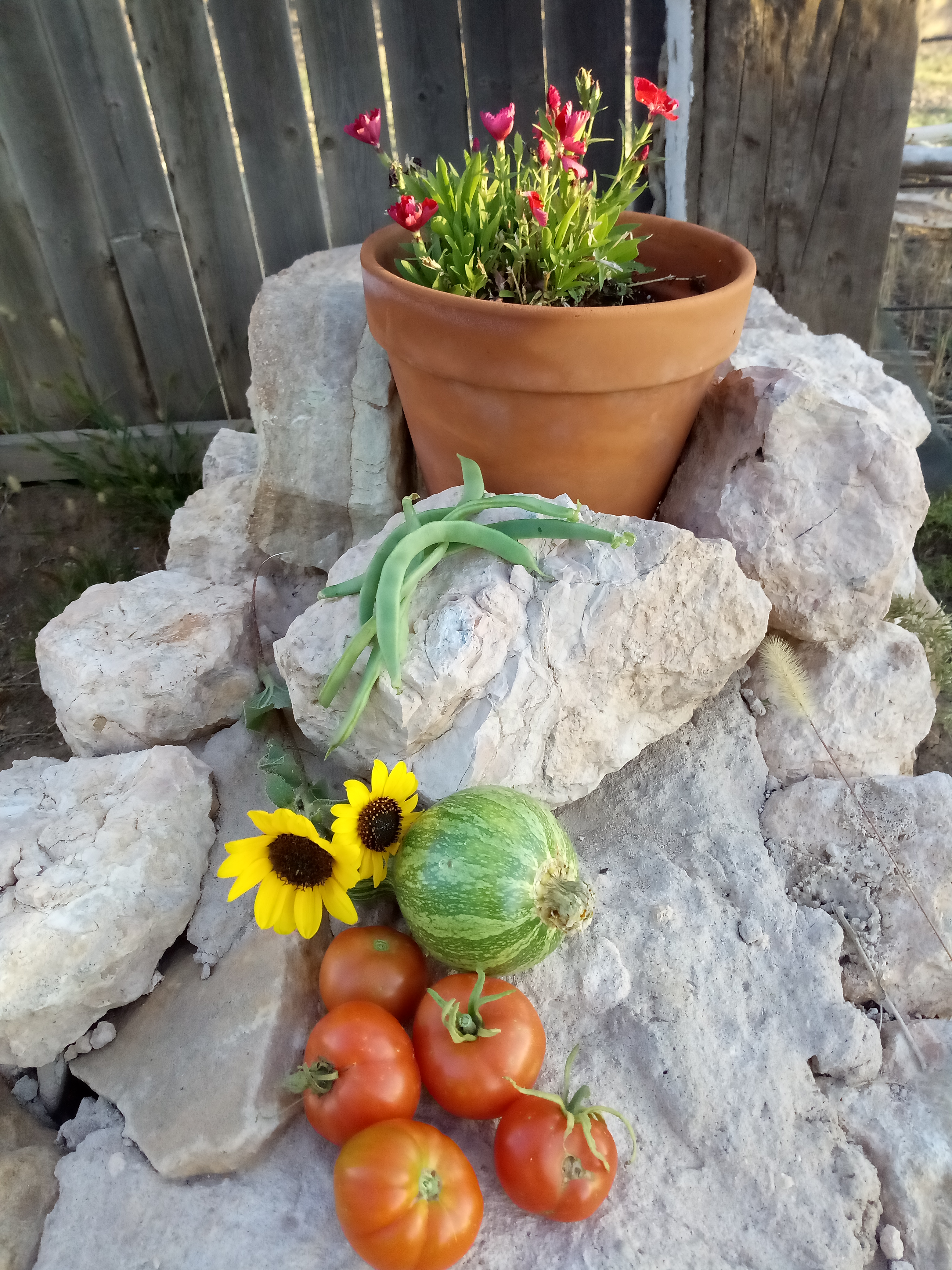
As a bonus inspirational plant story, allow me to show you my dianthus.


This is growing, but it's not food.

One of my children brought that home for me for Mother's Day last year. His teacher is a big flower gardener, so she divided the plants from her own garden. This is the best way to get plants, because it means they are guaranteed to grow in my area. 

I didn't have a place in mind for the plant, so I just put it in a pot. I put the pot on top of the wall dividing my vegetable garden, figuring that way I would remember to water it.

I did, and it bloomed continuously for months. I was so pleased with it. Then it got hot. And it wasn't getting enough water. And I thought maybe I had killed it.

However! We got several days of cool weather with a bit of rain, and there are the flowers again. Yay! I really need to put it in the ground. I think in a pot like that it would have to be watered every day, and that's not something I'm going to be doing.

So there you have it. Plants with a will to survive. Let them be a lesson to all of us as we go forth into our Tuesday. 

Onward.


Tuesday, September 12, 2023

Will We Make It?

This has been, to state the obvious, a highly unusual year in my garden. According to my previous posts--which is the only way I ever remember anything anymore--this is the time of year I would have quantities of tomatoes, green beans, and calabacitas.

However, thanks to the hail, grasshoppers and other insects, excess rain, and then drought, all of those are quite a bit behind.

I have a couple of green bean plants that are producing a few green beans, but not enough for a side dish.

The remaining tomato plants actually have a lot of flowers on them right now:


Floral arrangement.

And even quite a few actual tomatoes:


These are Stupice, which are typically my First Tomato.

We had two winter squash plants that survived the storm and cucumber beetles. They have half a dozen little squash on them.


This is the biggest one. It's about the size of a soup bowl.

The calabazas I replanted have a few tiny calabacitas on them, too. This is the biggest one of those:


It's about four inches long.

The random watermelon plants A. put in also have some watermelons of the vines.


Two of which decided to grow right next to each other.

This would all be very appropriate and hopeful if it were the beginning of August. But it's not. It's the middle of September. Our nights are already getting cooler. Our days are getting shorter. We can have a frost anytime in October, and none of these plants are cold hardy in the least.

So will we make it? I'm gonna say, barring a reeeeally long and warm Indian summer this fall . . . probably not.

I will certainly get some calabacitas, but I doubt we'll get a fully mature calabaza to store for winter. That one biggest squash might have time to mature, but I don't think any of the others on the plants will. We've already passed the really hot weather that the watermelons need to grow well.

That leaves the tomatoes. I will get some tomatoes this year. I will probably not get as many as the plants would produce, because I think it will get too cool, if not downright cold, for them to grow quickly and ripen well.

We'll see, though. All I can do is wait, because in this situation, as in so many others in gardening, it's all down to nature.

Tuesday, August 29, 2023

Growing Food: The New Mexico Wrap

Many moons ago, when the gardening season was still a time for starry-eyed visions of big boxes of tomatoes and crisper drawers full of cucumbers*, someone in the comments recommended I try the Florida weave to support my tomatoes.

I had never heard of it, so I looked it up. There are, of course, many videos showing it. I watched this one. Which is actually from the LSU Ag. Center, so maybe that's a Louisiana weave?

Anyway.

I tried it this year. 

A. split some cedar posts for me and pounded them into the ground about three feet apart. For the twine, I used the innumerable pieces of baling twine that are always hanging around after we cut them off of hay bales. I had to tie them together, of course, but it pleased me to use something that is otherwise just a nuisance to be thrown away. It's not going to win any design awards, but I enjoy such re-use.


Tomato post with very aesthetic baling twine.

The video shows the man just going on alternate sides of each post as he goes down the row until he gets to the end. This is presumably the "weave" part. I tried that the first pass, but then realized there is absolutely no point in that when it works much better to wrap the twine around each post a couple of times, ending up on the alternate side from the previous post and then continuing. 

This makes for a much tighter length of twine, and the tighter the twine, the better it holds the tomato plants upright. I have no idea why the video I saw didn't show this. Maybe everyone does it like that? Dunno.

This is why I'm re-naming my method The New Mexico Wrap. Catchy, no?

Anyway.

As the plant grows, more courses of woven twine are added above the existing ones to support the plants. The plants themselves can just be gently pulled inside the twine to hold them up. No tying.


This very sickly tomato plant allows us to see the plant inside the twine. The other plants are thankfully so robust that the twine has pretty much disappeared inside the foliage.

This has not been a year of really exuberant growth for my tomato plants (or, well, anything), but the tomatoes I have left are actually fairly big now, and the twine is holding them up. So I will do this again next year.

A couple of things I learned for next year, however.

As previously mentioned, do not just weave the twine in and out. Wrap it around each post as they come before continuing.

Smaller posts are better. The smaller the diameter of the posts (within reason), the closer together the two lengths of twine, and the better they hold the plants upright. 


This old stick where one plant died is about the right diameter. You can see the wrapping here, too.

I thought it would be great to have bamboo posts like I had at Blackrock, but then I remembered how slippery those bamboo posts were. I think the twine would probably slide down on them. Small diameter rough wood, either large sticks or small split wood, is better.

More posts are better. No more than two plants between each post seems to work pretty well.

So! To whoever recommended the Florida version to me, thank you. And to anyone else who wants to try it, feel free to make your own modifications and name it after your own location. It's fun.


Tuesday, August 22, 2023

Growing Food: Tenacious Flowers

Although some things in the garden are a total loss--alas for the basil--some of the plants are staging a comeback. And in plants, that looks like flowers.


A single hollyhock.


Calendula buds. Unfortunately, the grasshoppers REALLY like calendula blooms, so it's hard to get to enjoy them as flowers before they get devoured.


Volunteer lettuce. Oddly, the grasshoppers don't eat lettuce at all.


Green beans. I have exactly seven green bean plants left, and I have eaten exactly two green beans from them so far.


And tomatoes. There are even wee tomatoes on the remaining eleven plants. Thankfully, the grasshoppers don't seem to eat the foliage off the plants, although they do eat the fruits when they start to ripen, so I'll have to be vigilant.

We have about two months before our first frost, give or take a couple of weeks, and my fingers are crossed that some of those flowers will turn into food in my kitchen.

So tell me, my fellow gardeners: How does your garden grow?